Deep Cavity Reached the Pulp: An Emergency Root Canal in Los Angeles
Severe tooth pain can develop when decay has progressed far beyond the outer surface of a tooth. In this case, a patient came to Dr. David Hakham with strong pain in the lower right area. An examination and dental X rays showed a very large cavity in a lower molar. The decay had reached the pulp, which is the soft tissue inside the tooth.
The patient was looking for an emergency root canal in Los Angeles. Because the pulp tissue was involved and could not heal, repairing only the outside of the tooth with a filling would not address the source of the problem. Root canal treatment was completed to remove the affected tissue, clean and disinfect the canals, and seal the inside of the tooth. The patient was pain free after treatment in this individual case, and the natural tooth was retained.

Case Summary
Main concern: strong pain in the lower right molar area
Clinical finding: a very large cavity had reached the pulp
Why a filling was not enough: the tissue inside the tooth also required treatment
Treatment performed: affected pulp tissue was removed and the canals were cleaned, disinfected, filled, and sealed
Supported outcome: the patient was pain free after the procedure in this individual case
Important limitation: symptoms, treatment needs, and recovery experiences can vary
A Patient Came In With Severe Lower Molar Pain
The starting complaint was strong pain on the lower right side. Pain location is useful, but it does not provide a complete diagnosis by itself. A careful examination helps identify whether the discomfort comes from decay, the pulp, a crack, the gums, the bite, or another source.
The clinical examination and X rays in this case identified a large cavity in a lower molar. The images helped show how far the decay had progressed and how it related to the inner part of the tooth. This information was important because treatment for damage limited to the outer tooth is different from treatment for pulp tissue that is irreversibly inflamed or infected.


What It Means When a Cavity Reaches the Pulp
A tooth has several layers. Enamel covers the visible crown. Dentin lies beneath the enamel. The pulp is the soft tissue in the center of the tooth and within the roots. It contains nerves, blood vessels, and connective tissue.
Tooth decay begins at the outer surface and can gradually move deeper when it is not treated. Early decay may cause no symptoms. As decay advances, a tooth may become sensitive or painful. If the process reaches the pulp, the tissue may become severely inflamed or infected.
This does not mean that every large cavity automatically requires a root canal. The correct recommendation depends on the symptoms, the examination, pulp testing when appropriate, the amount of remaining tooth structure, and the X ray findings. In this specific case, the combined findings showed that the pulp required treatment.


Why a Filling Alone Was Not Enough
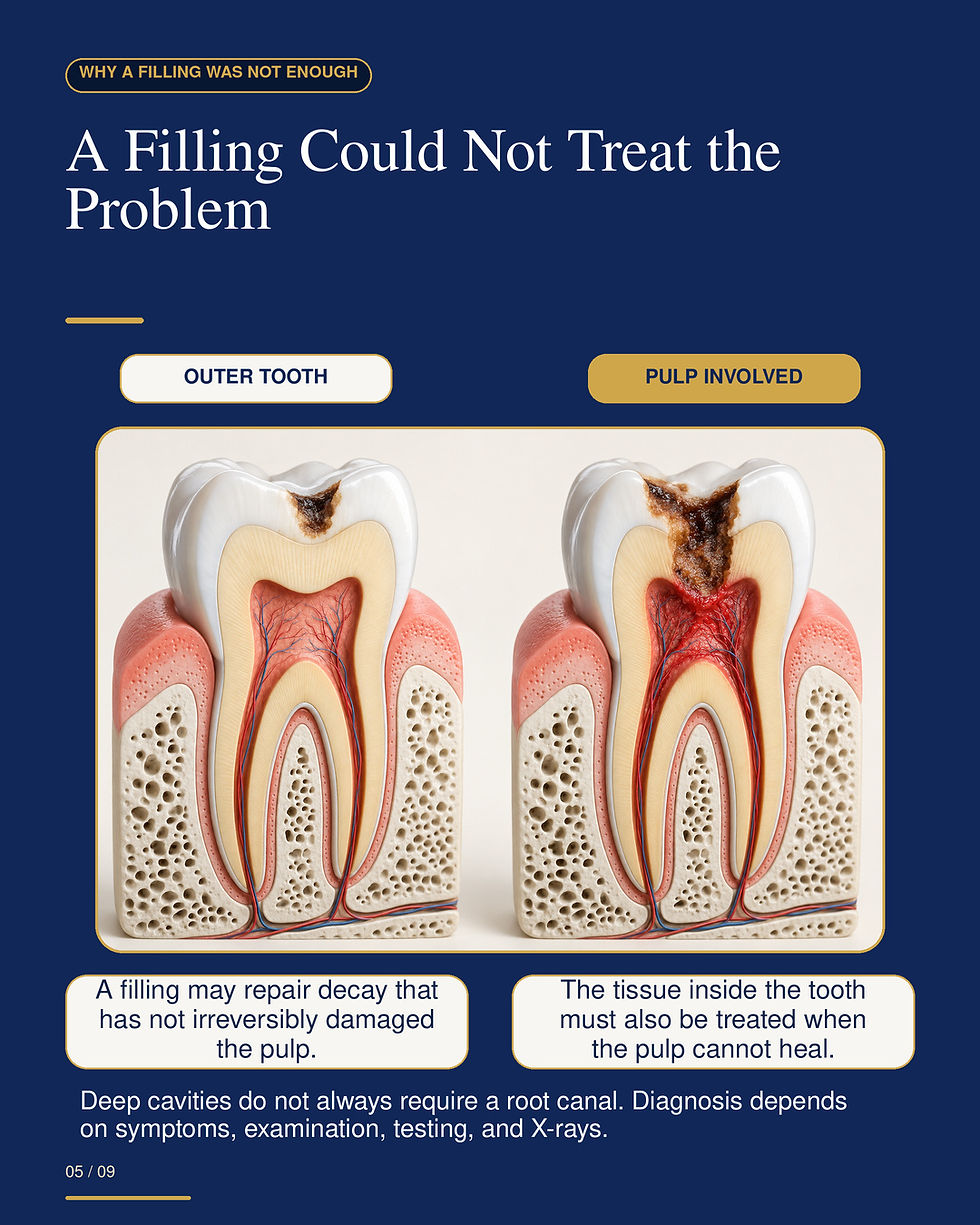
A dental filling replaces decayed or damaged outer tooth structure. It can be appropriate when the pulp remains healthy or can recover. A filling does not remove inflamed or infected tissue from the pulp chamber and root canals.
When pulp tissue cannot heal, sealing a filling over the outer portion of the tooth does not treat the affected tissue inside. That is why the depth of decay matters. The visible size of a cavity is only one part of the decision. The condition of the pulp must also be evaluated.
For this lower molar, the cavity had already reached the pulp. Root canal treatment was necessary to address the tissue inside the tooth. The goal was to treat the source of pain while retaining the natural tooth when clinically appropriate.
How Diagnosis Guides Emergency Root Canal Treatment
Severe tooth pain can feel urgent, especially when it interferes with chewing, sleep, or normal daily activity. Even so, pain alone does not determine treatment. A dentist must evaluate the tooth and surrounding tissues before deciding whether a root canal, filling, extraction, or another approach is appropriate.
Dental X rays can show decay that is difficult to judge from the surface alone. They can also help evaluate the roots and surrounding bone. Clinical tests add information about how the pulp responds and whether the tooth can be predictably restored.
This diagnostic process helps avoid two problems: treating a tooth that does not need a root canal and delaying treatment when the pulp is no longer able to heal. The recommendation should be based on the complete clinical picture rather than one symptom or one image by itself.
How Root Canal Treatment Addressed the Source
Root canal treatment focuses on the inside of the tooth. An access opening allows the dentist to reach the pulp chamber and root canals. The affected pulp tissue is removed, and the canal spaces are carefully cleaned and shaped.
The canals are then disinfected to reduce bacteria and debris. After cleaning and preparation, the spaces are filled and sealed. These steps address the internal tissue that a regular filling cannot reach.
The exact treatment sequence and number of visits can vary according to the tooth and clinical findings. Treatment details are selected for the individual tooth after examination and review of the dental X rays.


The Outcome in This Individual Case
After the root canal procedure, the patient was pain free. The natural lower molar was retained. The after treatment X ray shows the completed canal filling inside the roots.
This result describes one patient and should not be treated as a guarantee. Pain levels, healing, tooth condition, and long term prognosis can differ. The final recommendation and expected outcome depend on the condition of each tooth and the surrounding tissues.

Does Every Severe Toothache Need a Root Canal?
No. Severe tooth pain has several possible causes, and not every painful tooth has irreversible pulp damage. Some teeth may need a filling, adjustment, gum treatment, treatment for a crack, or another form of care. Other teeth may not be restorable. The correct choice requires diagnosis.
A root canal may be recommended when the pulp is inflamed or infected and cannot recover. Deep decay is one possible cause. Cracks, repeated dental procedures, or injury can also affect the pulp. Symptoms and X rays must be interpreted together with the clinical examination.
When to Seek an Emergency Dental Evaluation
Severe or persistent tooth pain should not be ignored. Pain with chewing, lingering sensitivity to hot or cold, swelling, tenderness, or a visibly damaged tooth can be reasons to arrange a prompt dental examination. These symptoms do not prove that a root canal is needed, but they do indicate that the tooth should be evaluated.
Untreated tooth decay can progress and may cause pain, infection, or tooth loss. Earlier evaluation gives the dentist more information and may preserve more treatment options. If pain is strong, worsening, or accompanied by swelling or fever, contact a dental office promptly for guidance.
Why Timely Care Matters for Preserving a Natural Tooth
The main goal is not to perform a root canal simply because a tooth hurts. The goal is to identify the source of the problem and recommend the least extensive treatment that can predictably address it. When the pulp can recover, more conservative treatment may be possible. When the pulp cannot heal, delaying the necessary treatment may allow the condition to worsen.
In this case, root canal treatment addressed the affected tissue and allowed the natural molar to remain in place. Keeping a natural tooth can support normal chewing and help maintain the surrounding teeth, but preservation must always be based on the condition and restorability of the individual tooth.
Why Choose Dr. David Hakham for an Emergency Dental Evaluation?
Dr. David Hakham is a graduate of the USC School of Dentistry with more than 17 years of experience. His approach emphasizes careful diagnosis, clear explanations, conservative treatment planning, and preservation of natural tooth structure whenever appropriate.
The office serves patients from Montebello, Los Angeles, East Los Angeles, Commerce, Downey, and nearby communities. If you are experiencing severe toothache, the first step is an examination and the appropriate dental X rays so that Dr. Hakham can explain the findings and available treatment options.
Patient Takeaways
A cavity can become painful when decay progresses toward the pulp.
A filling repairs outer tooth structure but cannot treat pulp tissue that cannot heal.
Not every toothache requires a root canal.
Examination, clinical testing, and X rays guide the treatment recommendation.
Prompt evaluation may help preserve more treatment options.
Schedule an Emergency Dental Examination
If you are experiencing severe toothache, call Dr. David Hakham at 323-728-0241 for an examination and treatment recommendations. The office is located in Montebello and serves patients from Montebello, Los Angeles, East Los Angeles, Commerce, Downey, and nearby communities.

Frequently Asked Questions
When does a deep cavity need a root canal?
A root canal may be needed when deep decay causes pulp inflammation or infection that cannot heal. The dentist considers symptoms, examination findings, clinical tests, X rays, and whether the tooth can be restored before making a recommendation.
Can a filling fix a cavity that has reached the pulp?
A filling can replace decayed outer tooth structure, but it cannot remove affected tissue from the pulp chamber and root canals. If the pulp cannot heal, treatment inside the tooth may be necessary.
Does severe tooth pain always mean I need a root canal?
No. Severe tooth pain can have several causes. An examination and X rays are needed to determine whether the tooth needs a root canal or another type of treatment.
Can root canal treatment help retain a natural molar?
Root canal treatment may allow a restorable tooth with affected pulp tissue to remain in place. The prognosis depends on the amount of remaining tooth structure, the condition of the roots and surrounding tissues, and the final restoration plan.
What should I do if I have a severe toothache in Los Angeles or Montebello?
Contact an emergency dental office promptly for an examination. Dr. David Hakham serves patients from Montebello and Los Angeles and can evaluate the tooth, review the X rays, and explain the appropriate treatment options.


